

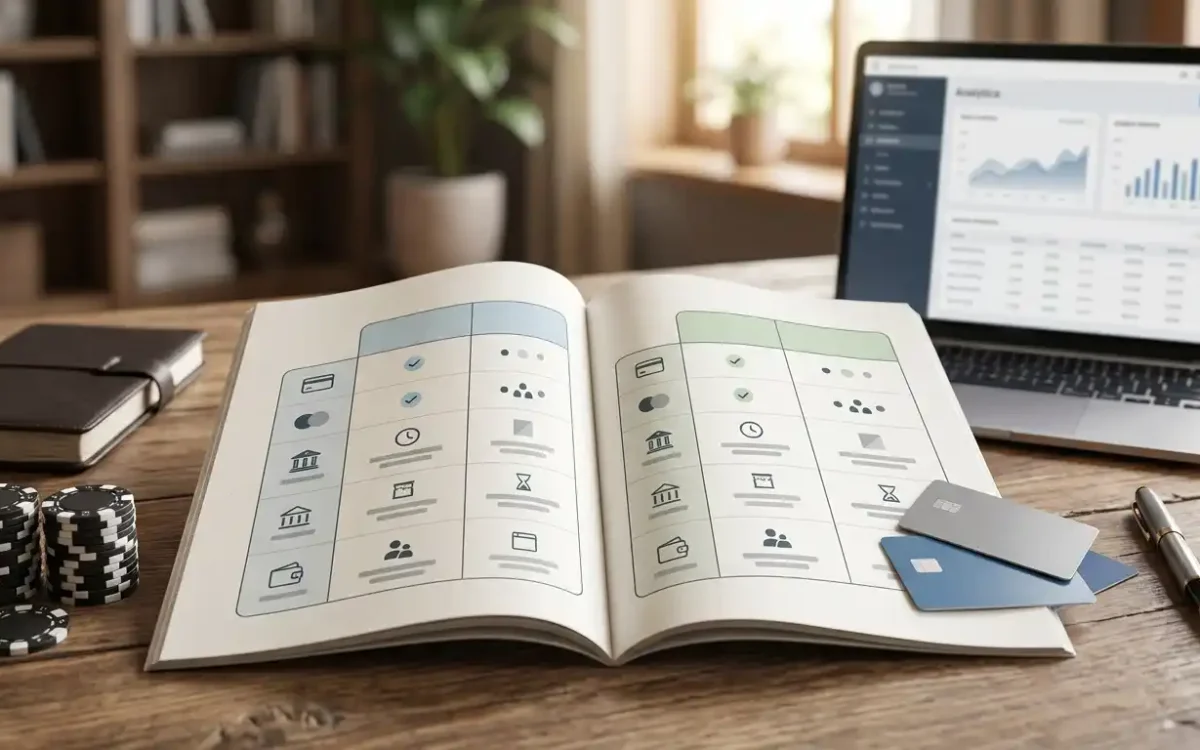
Verified and unverified payment points
Payment research fails when published terms and live behaviour get blended into a single confident summary. They are different kinds of evidence. What the terms say can be quoted. What the cashier does can only be confirmed by opening it. The table keeps both columns visible so the difference stays actionable.
| Topic | What the reviewed terms state | UK caveat |
|---|---|---|
| Account currencies | Official terms list EUR, USD, CAD and AUD as fiat options, plus cryptocurrencies including BTC, ETH, BCH, XRP, USDT, DOGE and LTC. | GBP does not appear in that text. Do not assume a sterling account currency without checking the cashier. |
| Fiat deposit minimums | Minimum deposits of 20 EUR/USD and 30 CAD/AUD. | No verified GBP minimum was found anywhere in the official terms. |
| Fiat withdrawal minimums | Minimum withdrawals of 20 EUR/USD and 30 CAD/AUD. | The GB page also quotes £20 or currency equivalent. Method-specific minimums still need checking at cash-out. |
| Withdrawal limits | Daily, weekly and monthly withdrawal limits stated in EUR/USD and CAD/AUD. | Do not convert those ceilings into a sterling table unless the live terms or cashier display GBP values. |
| Bank-transfer timing | All bank-transfer payouts are processed within 5-7 banking days. | Processing is not arrival. Receipt depends on the receiving bank and any intermediate clearing. |
| Verification | The terms allow withdrawals to be held while identity is checked, and the GB page says payouts are released only after the account is verified. | Prepare documents before a withdrawal becomes urgent, particularly if the deposit method must be matched. |
The currency caveat in plain terms
One detail on this page outweighs the rest, and it is not a fee or a limit. It is the question of which currency your account is actually held in. The official accepted-currency text names EUR, USD, CAD, AUD and a list of cryptocurrencies. Sterling is not among them. The GB-facing landing page, meanwhile, prices its welcome promotion in pounds and quotes a £20 minimum withdrawal. Those two observations do not contradict each other. An interface can display sterling figures over an account that settles in something else entirely.
The consequences are practical. Conversion comes first: if the cashier settles in euros or dollars, every sterling figure you saw in marketing is converted at a rate the operator chooses, and that rate need not track the interbank market. Payment-method fees can widen the gap again on both legs of the journey. Record-keeping comes second, and it matters more than it sounds. A player who wants a clean record of what went in and what came out will struggle if display currency and settlement currency disagree.
The check itself takes a minute. Open the cashier, start a deposit, and read the currency shown at the confirmation step rather than the one on the banner. Look for any conversion notice. If marketing shows pounds and the confirmation screen offers something else, exchange rates and bank charges belong in your decision before you approve the transaction.
Deposit minimums and routine checks
The official terms set minimum deposits in EUR, USD, CAD and AUD, with no verified sterling equivalent. In practice the number that governs your transaction is the one on the deposit screen, so read the confirmation message rather than reasoning from the terms. A deposit form displaying GBP is still not proof of GBP at account level, since the conversion can happen behind the confirmation.
Two further details reward attention. Welcome offers sometimes carry their own minimum, an opt-in step, or a required payment method that differs from the standard cashier rules, and some promotions exclude methods that work perfectly well for ordinary deposits. Those bonus-side conditions are covered in LuckyTwice bonus terms. On the cashier side, confirm that whichever method you choose can also return funds, so that money can leave by the route it arrived.
Withdrawal limits and processing timing
The withdrawal picture comes from two documents that need reading together. The general terms set daily, weekly and monthly limits in EUR/USD and CAD/AUD, list 20 EUR/USD and 30 CAD/AUD as fiat minimums, and state that bank-transfer payouts are processed within 5 to 7 banking days. The GB page adds that requests go through the My Account section, that payouts return to the deposit method, that verification must be complete first, and that large withdrawals may be split into instalments.
None of that guarantees an outcome, and the wording repays close reading. A processing window describes what the operator undertakes to begin, not when a UK bank credits an account. Instalment language means a substantial balance may arrive in several payments, each capable of triggering its own review. The withdrawal limits and timing page follows that sequence step by step.
Identity checks as a payment issue
Verification is usually filed under account admin, which is where players get caught out. For payment purposes it belongs inside the withdrawal flow, because it is the stage at which a payout can stop. The LuckyTwice terms permit requests for identification documents, payment-system details, utility bills and, in some cases, video verification, and they allow a withdrawal to be held while those checks run.
Three consequences follow. The deposit route can feel effortless while the withdrawal route still waits on document review. A mismatch of name or address between the registration form, the identity document and the payment instrument can stall a payout that was otherwise routine. And the timing of a request is not predictable: documents may be asked for at registration, before a first withdrawal, or only after a larger transaction prompts an extra look. Having identity, address and payment-ownership evidence ready in advance is what keeps a standard check from turning into a dispute. The document side is covered on the account verification checks page.
Payment trust signals to read
A logo strip proves that a brand has integrated a payment provider. It proves nothing about how that brand behaves when a payout is inconvenient. The signals worth weighing are duller and more useful: whether currency handling is explained at confirmation, whether withdrawal rules can be found from inside the cashier, whether support answers method-specific questions without deflecting, whether bonus rules can delay a payout, and whether the operator’s licence position clears your own risk threshold. LuckyTwice does set out accepted currencies, minimums, limits, bank-transfer timing and identity checks in writing, which is more than some brands manage. No public-register evidence of a UKGC licence was found in this research.
For the wider safety context, read the payment trust checks page.
Payment-method ownership
Use methods held in your own name, without exception. A partner’s card, a wallet topped up by someone else or a transfer from a business account can all pass at the deposit stage and then fail at verification, which is the worst possible order for that to happen in. Operators generally expect a withdrawal to travel back along the deposit route, and cash-out checks can demand evidence that one person owns both ends of it.
Two habits prevent most of the trouble. Keep deposits and withdrawals on the same instrument wherever the cashier allows it, and keep the name and address on every payment method consistent with the account profile. Accounts that mix names, addresses or payment owners generate withdrawal disputes that have nothing to do with how the player performed.
First-deposit checklist
Run these checks in order before the first deposit. They are deliberately conservative, because a payment route that feels comfortable on the way in tells you very little about the way out.
- Open the cashier and note the account currency shown at confirmation, not the one on the landing page.
- Check whether the cashier discloses a fee, a conversion rate or a surcharge before you approve.
- Confirm the chosen method also supports withdrawals back to the same instrument.
- Read the withdrawal rules for that specific method, including minimums and method-level limits.
- Locate the identity-verification page from the account area before making any transaction.
- Choose a deposit amount that does not need a fast withdrawal to have been worthwhile.
Why deposit comfort is not withdrawal comfort
Money moving in and money moving out are approved by different systems. A deposit clears the payment network and the operator’s deposit controls, both of which are designed to say yes quickly. A withdrawal clears the payout controls, which can include identity review, separation of bonus balances, payment-method matching and internal risk scoring. A method that accepts funds in seconds may still hold a payout for days while a document is read. Treating the deposit experience as a preview of the withdrawal experience is the single most common reason a payment choice looks fine until the moment it matters.
Quick payment answers
Does LuckyTwice clearly support GBP as an account currency?
Not in the retrieved official accepted-currency text, which lists EUR, USD, CAD, AUD and several cryptocurrencies. The GB page uses a £20 minimum-withdrawal phrase, so confirm the account currency in the live cashier.
What withdrawal minimum should UK readers note?
The GB page quotes £20 or currency equivalent. The general terms list 20 EUR/USD and 30 CAD/AUD as fiat minimums.
Are bank-transfer withdrawals instant?
No. The official terms say bank-transfer payouts are processed within 5-7 banking days, which is the operator-side window rather than a guaranteed credit time.
Can LuckyTwice ask for identity documents before paying?
Yes. The terms allow requests for identification documents, payment-system details, utility bills and, in some cases, video verification.
Are large withdrawals paid in one go?
Not necessarily. The GB page says large withdrawals may be paid in instalments.
Where to go next
Use the withdrawal limits and timing page for payout mechanics, the KYC before payments page for the document side, the safety and reputation page for trust context, and the payments FAQ for short answers. The full LuckyTwice UK review holds the overall position.