Is LuckyTwice Safe for UK Players?
 Available in GB
LuckyTwice is not verified as holding a UK remote casino operating licence. That single observation is the central UK safety signal, and it is not the same as a confirmed prohibition: the brand presents a Great Britain facing page with GBP-denominated welcome wording, and no hard-stop on UK access was confirmed in this research. For UK readers, the safer reading sits in the middle. Remote gambling offered to consumers in Great Britain falls under the Gambling Commission’s remit, and operators serving Great Britain normally need a remote casino operating licence. Until a current Gambling Commission register entry matches the brand and operator, do not treat LuckyTwice as locally licensed, and do not assume that the dispute and account-control routes available at UKGC-authorised operators apply here.
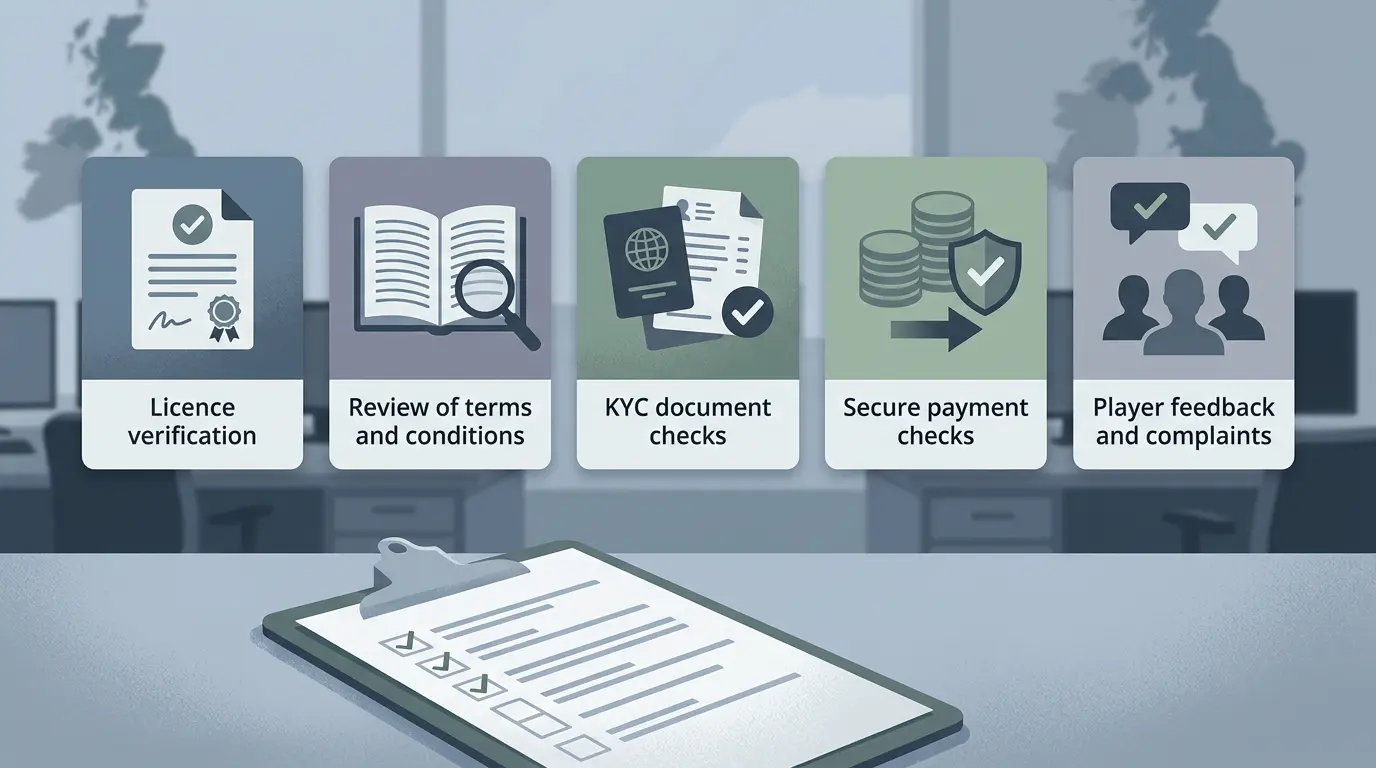
Table of Contents
- Licence status as the first signal
- Trust signals, sorted by weight
- Third-party safety summaries
- Operational controls described in the terms
- Responsible gambling and account controls
- Pre-registration verification checklist
- Common safety misreadings
- Practical risk patterns to watch
- What would change the safety assessment
- Quick safety answers
- Where to go next
Licence status as the first signal
The Gambling Commission is the statutory regulator for remote gambling offered to consumers in Great Britain. A remote casino operating licence is the standard authorisation, and it brings with it advertising standards, account-control expectations, dispute escalation routes through approved alternative-dispute-resolution providers, and ongoing reporting obligations. None of that automatically applies to an operator that is not on the register.
For LuckyTwice, no UK Gambling Commission licence was identified in the public register during research. UK availability signals – a GB-facing page, GBP-denominated promotional wording, a £20 minimum-withdrawal phrase – are interface signals about reach rather than evidence of authorisation. The cautious framing therefore treats licence and reach as two separate columns and decides on the licence column first. For the focused licence-side detail, the UK licence check page sets out the register-check procedure.
Trust signals, sorted by weight
| Signal | Source | Weight in a UK decision |
|---|---|---|
| Local licence position | UK Gambling Commission public register, official legal footer. | High. Drives dispute routes and advertising rules. |
| Stated currency and minimums | Official terms and GB-facing landing page. | High. Affects deposit and withdrawal mechanics. |
| Identity verification rules | Official terms. | Medium-high. Determines payout timing and document needs. |
| Third-party safety summaries | Casino Guru, Trustpilot, independent industry coverage. | Medium. Useful as risk signals, not as authority. |
| User reviews | Public forums and consumer-review sites. | Low to medium. Read for patterns rather than individual cases. |
| Marketing copy | Operator’s own promotional pages. | Low. Useful as a description of intent, not as evidence of fact. |
Third-party safety summaries
Independent industry sources rate operators on signals such as licence presence, terms readability, complaint history and payout behaviour. Casino Guru, which is the most widely cited free safety-index aggregator, has assigned Lucky Twice a very low Safety Index and states that it knows of no official gambling licence for the brand. That is third-party opinion based on publicly available signals; it is not a regulatory determination, and it can change if new evidence appears. UK readers should treat such ratings as a risk signal that aligns with the absence of a verified UKGC licence rather than as a separate authoritative source.
Trustpilot and similar review platforms collect user-generated feedback. Individual reviews vary in detail and motivation, and operators can solicit or dispute reviews. The useful approach is to read for repeated patterns – delays at the same step, recurring document-mismatch reports, consistent complaints about a specific bonus mechanic – rather than to weigh a single review heavily either way.
Operational controls described in the terms
The LuckyTwice terms describe identity verification, payment-method matching for withdrawals, withdrawal limits, processing windows for bank transfers and the possibility of large withdrawals being paid in instalments. The terms also describe the operator’s right to request identification documents, payment-system details, utility bills and, in some cases, video verification. The GB-facing page adds that withdrawals are processed only after the account is verified and lists a £20 minimum withdrawal or currency equivalent.
None of those rules is unusual in the regulated industry. The question for a UK reader is not whether the rules exist – they should – but how they interact with the licence question. At a UKGC-licensed operator, account-control and payout rules sit inside a regulatory framework that includes a dispute escalation route. At an operator without a verified UKGC licence, the same rules may apply, but the external escalation route changes. The payments risk checks page covers the payment-side detail in more depth.
Responsible gambling and account controls
UK-facing gambling content should keep responsible-gambling framing visible. The LuckyTwice site discusses responsible play and references account-control features such as deposit limits and self-exclusion routes. Specific control wording must be checked in the live account area, since site copy and the in-account settings can drift between releases. A UK reader should expect to see deposit-limit controls, time-out options, a self-exclusion route and links to independent support such as GamCare or the National Gambling Helpline.
For UK players who are concerned about controlled play, the strongest stop-gap is to use independent national tools where possible. UK-licensed operators participate in the GAMSTOP self-exclusion scheme. An operator without a verified UKGC licence may not be part of that scheme, so a national self-exclusion request will not automatically apply to it. The responsible-gambling tools page covers the in-account controls and the external support routes.
Pre-registration verification checklist
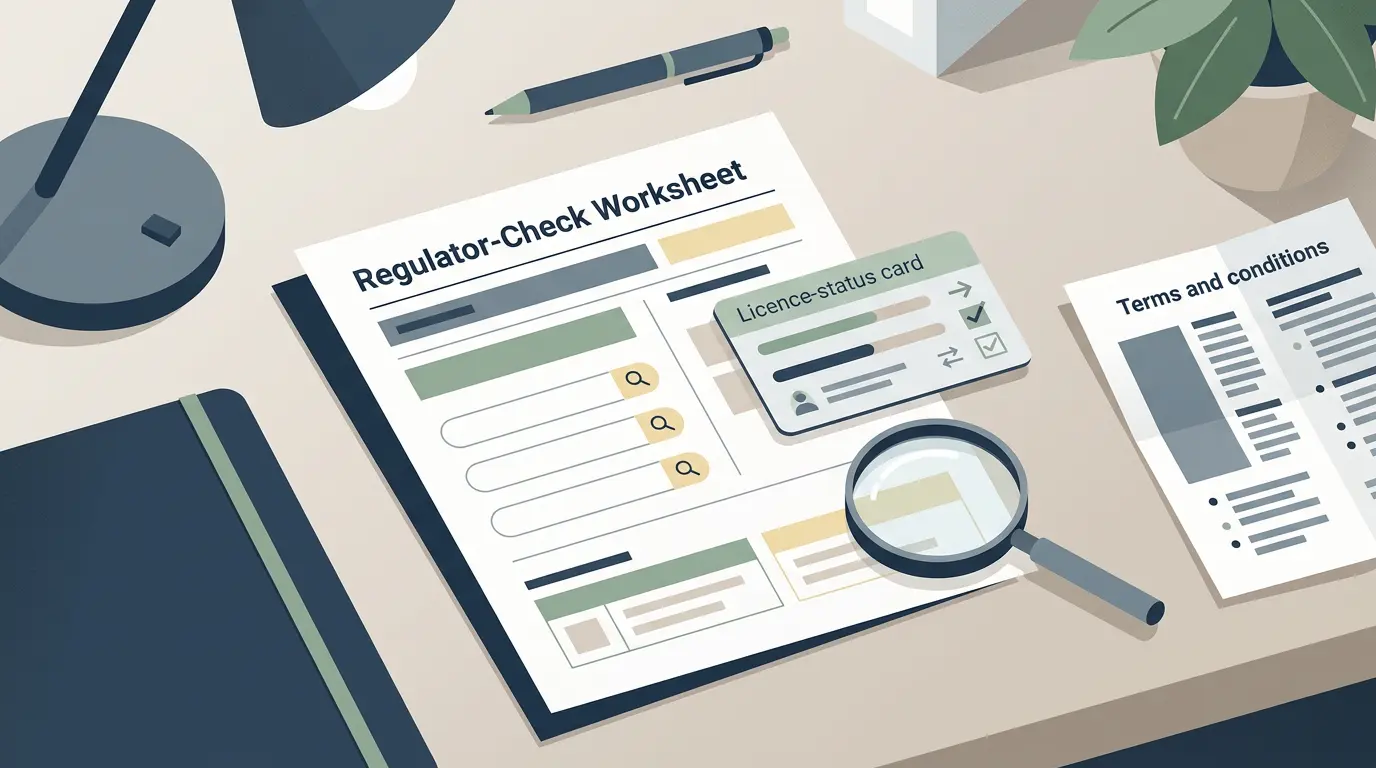
- Search the Gambling Commission public register for “Lucky Twice”, “LuckyTwice” and the luckytwice.com domain. Match any register result against the operator name in the legal footer.
- Read the current terms and conditions, including the latest version date, before accepting them.
- Confirm what account currency the cashier offers at the point of confirmation rather than relying on landing-page sterling figures.
- Find the responsible-gambling page from the account area; verify that deposit limits and self-exclusion are accessible without contacting support.
- Search recent third-party coverage by date – aged commentary may not reflect the current operator setup.
- Decide a deposit size that does not depend on a fast payout to remain affordable.
Common safety misreadings
Several patterns produce a more favourable safety picture than the underlying evidence supports. A GB-facing localisation is read as proof of UK authorisation. A welcome offer in pounds is read as proof of a sterling account. A successful first deposit is read as proof of a smooth withdrawal route. A visible provider list is read as proof of full game access. None of these inferences holds in isolation. Each signal carries its own weight and should be assessed against the central licence question rather than fed into a single composite verdict.
The other recurring pattern is symmetry bias: assuming that any operator with a GB page must be roughly equivalent in trust to any UKGC-licensed operator. The presence or absence of a current UKGC entry is a categorical distinction that affects dispute routes, marketing rules and the day-to-day controls a player can expect.
Practical risk patterns to watch
Beyond the headline licence question, several smaller patterns tend to predict downstream friction at any operator. They are not specific accusations against LuckyTwice; they are general signals that UK readers can apply to it in the same way as to any other brand.
The first is terms-page drift. If two pages on the same site describe the same rule differently – for example a landing page showing a sterling figure while the cashier settles in a different currency – the underlying agreement is the one in the formal terms, not the one in the marketing. Save a screenshot of the terms version that applied at registration and check the version date later. The second is bonus-rule density. Long lists of excluded games, low maximum bonus bets and short expiry windows are not unusual, but stacked together they compress the effective value of a headline figure.
The third is support latency. A measured way to test support is to send a specific, neutral question – for example, asking how withdrawal-method matching applies if the original deposit method is no longer available – and to note both the response time and whether the answer references the actual terms. The fourth is the responsible-gambling pathway: deposit limits, time-outs and self-exclusion should be reachable from the account area without contacting support. Friction at this layer is a strong signal regardless of other factors.
Finally, watch for changes to the licence claim itself. Some operator pages display historic licence references that do not correspond to a current public-register entry, or that name a different operating entity than the one on the legal footer. Any mismatch between the legal footer, the terms and the regulator’s own register is a reason to slow down and verify before depositing.
What would change the safety assessment
The assessment would improve if a current UKGC public-register entry were identified and matched to the operator, if the terms aligned cleanly with UK consumer-protection expectations, and if third-party safety signals shifted in line with that change. It would worsen if user-review patterns showed consistent payout complaints tied to a specific mechanic, if the GB-facing copy were removed without explanation, or if support became unresponsive on documented questions. Until then, the careful position remains the cautious one.
Quick safety answers
Is LuckyTwice safe for UK players?
No UK Gambling Commission licence for LuckyTwice was verified during research. Treat that as a serious UK caveat. The brand presents a GB-facing page, so it is not the same as a confirmed prohibition.
Does the Gambling Commission cover LuckyTwice?
Remote gambling offered to consumers in Great Britain falls under the Gambling Commission’s remit. Operators serving Great Britain normally need a remote casino operating licence. A matching public-register entry has not been identified for LuckyTwice in this research.
What do third parties say about LuckyTwice?
Casino Guru has rated the brand with a very low Safety Index and states it knows of no official gambling licence. Trustpilot offers user feedback that should be read for patterns rather than as individual authority.
Are responsible-gambling controls available?
The site references responsible play and account-control features. UK players concerned about controlled play should also consider GAMSTOP and independent support such as GamCare or the National Gambling Helpline. GAMSTOP coverage is associated with UKGC-licensed operators.
Where can I read the licence-side detail?
The UK licence check page sets out the register-check procedure and what the absence of a confirmed entry implies for UK readers.
Where to go next
Continue to the Gambling Commission check for the licence-side detail, the UK rules context for the legal framework, the responsible-gambling tools page for support and limits, and the payments page for cashier caveats. Return to the main LuckyTwice UK review for the overall verdict.
Published by the Lucky Twice Casino team.