
Is LuckyTwice Safe for UK Players?
Loading...
The reviewed material does not confirm a UK Gambling Commission licence for LuckyTwice, and that is the central UK safety caveat. Remote gambling offered to consumers in Great Britain falls under the Gambling Commission’s remit, and operators serving Great Britain normally need a Gambling Commission remote casino operating licence. That does not prove LuckyTwice rejects every UK visitor, and it is not legal advice. It does mean UK readers should not treat LuckyTwice as locally licensed unless they can find a current public-register entry and matching operator details.
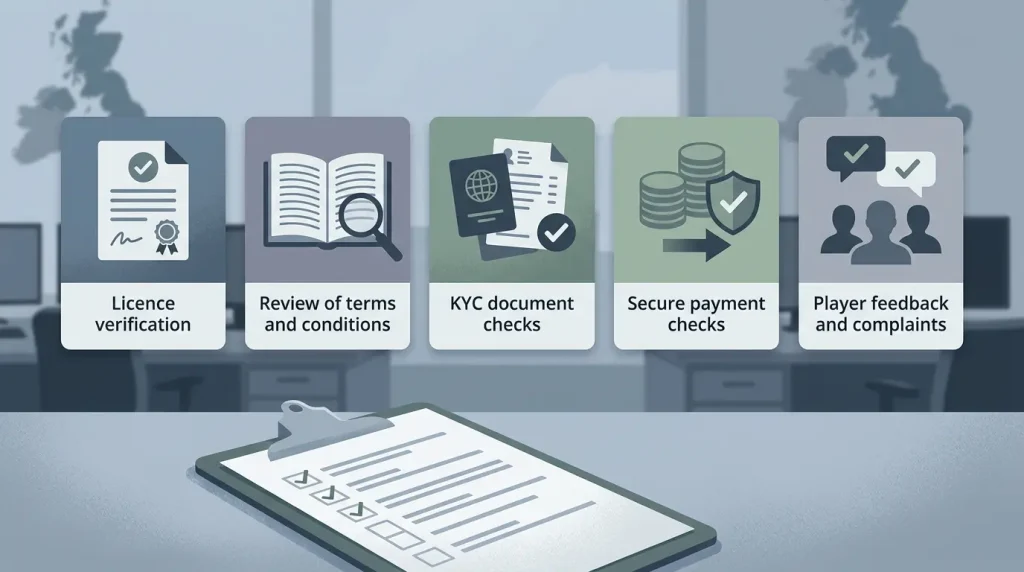
This trust review separates three types of evidence: regulator checks, official site terms, and third-party risk signals. The cautious conclusion is simple: verify licence status, account eligibility, KYC, payment rules and safer-gambling controls before placing any reliance on the brand.
Quick trust verdict
LuckyTwice should be approached as a high-caveat option for UK readers. The verified evidence supports the official Lucky Twice / Lucky Twice Casino spelling and the review process observed the official URL as luckytwice.com. The evidence did not verify a UKGC licence. Because UK-facing gambling content should avoid promotional pressure and keep responsible-gambling framing visible, this page does not make signup recommendations or claim that play is risk-free.
| Area | What was found | How to treat it |
|---|---|---|
| UK licence | The reviewed material does not confirm a UK Gambling Commission licence for LuckyTwice. | Treat any UKGC-licensed claim as unsupported unless you confirm it in the public register. |
| Regulatory context | Remote gambling offered to Great Britain consumers is within the Gambling Commission framework. | Use the licence check as a first-order safety screen, not as a casual detail. |
| Third-party safety | Casino Guru gives Lucky Twice a very low Safety Index and says it knows of no official gambling licence. | Use this as a third-party risk signal, not as a regulator finding. |
| Player reviews | Trustpilot reviews are user- and include payment and support complaints. | Read patterns cautiously; individual reviews are not verified operational facts. |
Why the UKGC check matters
For a UK reader, a local licence is not just a badge. It is connected to responsible-gambling obligations, advertising standards, dispute expectations and regulator oversight. The research file for this site records that operators serving Great Britain normally need a Gambling Commission remote casino operating licence. Since no such licence was verified for LuckyTwice, the safer editorial stance is to describe LuckyTwice as unverified for UKGC licensing rather than locally licensed.
This is different from saying the casino is definitely unavailable to every UK visitor. This review did not validate a hard stop that proves universal non-acceptance. The more accurate position is narrower: do not rely on local licence protection unless the public register and the site’s legal footer align.
For the focused method, use the LuckyTwice UK licence check. For broader player-law context, read the UK rules context.
Third-party reputation signals
Third-party review sites can be useful, but they should not be inflated into official proof. Casino Guru’s Lucky Twice page is a negative signal because it describes a very low Safety Index and says it knows of no official gambling licence. That matters because the signal points in the same direction as the unverified UKGC finding: readers should pause and check the underlying facts before depositing.
Trustpilot is different. It is a public review platform, so its value is in themes rather than definitive facts. Reviews can highlight complaints about support, payment handling or account experience, but they can also be incomplete, duplicated, emotional or outdated. Use them to decide what questions to ask, not to prove every operational detail.
Non-generic insight
The useful trust question is not “does LuckyTwice have reviews?” It is whether independent signals, public-register evidence and official terms all point in the same direction. The public-register caveat and third-party safety warning are not reassuring enough to treat the brand as low-risk for UK readers.
Official terms, KYC and withdrawals
A trust review should also look at operational frictions. KYC checks, account reviews and withdrawal conditions are normal in regulated gambling, but vague or poorly signposted processes can become a practical risk for players. This page does not claim LuckyTwice is no-KYC, instant-payout or guaranteed to process withdrawals within a fixed time. Those would be unsupported claims.
Before registering, check whether the current terms describe identity documents, source-of-funds checks, restricted countries, bonus abuse rules, dormant-account rules, complaint handling and withdrawal limits. Then compare those findings with the payments risk checks and the account-verification page when it is available.
Responsible gambling and promotional pressure
UK-facing gambling information should keep safer-gambling context visible and avoid pressure. That is especially important when local licence evidence has not been verified. The practical test is whether a player can find account controls, time-outs, self-exclusion information, support routes and clear instructions for closing an account before they need them.
Do not use gambling as a way to solve financial problems. If gambling stops feeling controlled, pause and use support resources. The dedicated responsible gambling tools page explains which account-control questions to check for LuckyTwice.
Pre-registration safety checklist
- Search the Gambling Commission public register for the brand name, domain and any named operator.
- Check the legal footer on the live LuckyTwice site and compare it with the register result.
- Read the terms for country restrictions, account closure, KYC and complaints.
- Read payment pages before depositing, especially withdrawal conditions and pending-period rules.
- Treat bonus claims as conditional until the exact promotion terms are visible in your account.
- Check whether account limits, time-outs and self-exclusion options are easy to find before playing.
How to separate trust signals from marketing
Trust signals are useful only when they can be checked outside a promotional claim. A logo, a large game count or a bonus headline should not carry the same weight as a public licence record, clear terms, visible payment rules and accessible responsible-gambling tools. For LuckyTwice, the conservative approach is to give more weight to verifiable documents than to design, offers or general brand presentation.
A reader who wants a lower-risk choice should look for consistency. The operator name, licence details, terms, cashier information and support answers should all point in the same direction. If one page looks UK-facing but another page leaves eligibility or authorisation unclear, the uncertainty should remain part of the decision.
Trust conclusion in practical terms
The cautious conclusion is simple: do not let design quality, game variety or bonus size outweigh licence, payment and safer-gambling checks. Trust should be built from verifiable information, not from the most attractive part of the site.
Trust depends on licence and withdrawal verification
LuckyTwice is not confirmed as UKGC-licensed in the reviewed material. Casino Guru also reports a very low Safety Index and no official gambling licence known to it, while player-review platforms should be treated as cautionary signals rather than proof. The safest editorial conclusion is to proceed only with verification, avoid promotional assumptions and keep payment, KYC and responsible-gambling checks at the centre of the decision.
Return to the review hub for the overall LuckyTwice UK assessment.
Is LuckyTwice Safe for UK Players?
Created by the "Lucky Twice Casino Play UK" editorial team.